
Walk-In Cooler Not Working Right? Check the Door Seal Before You Call for Repair
May 26, 2026 · Cal Gaskets
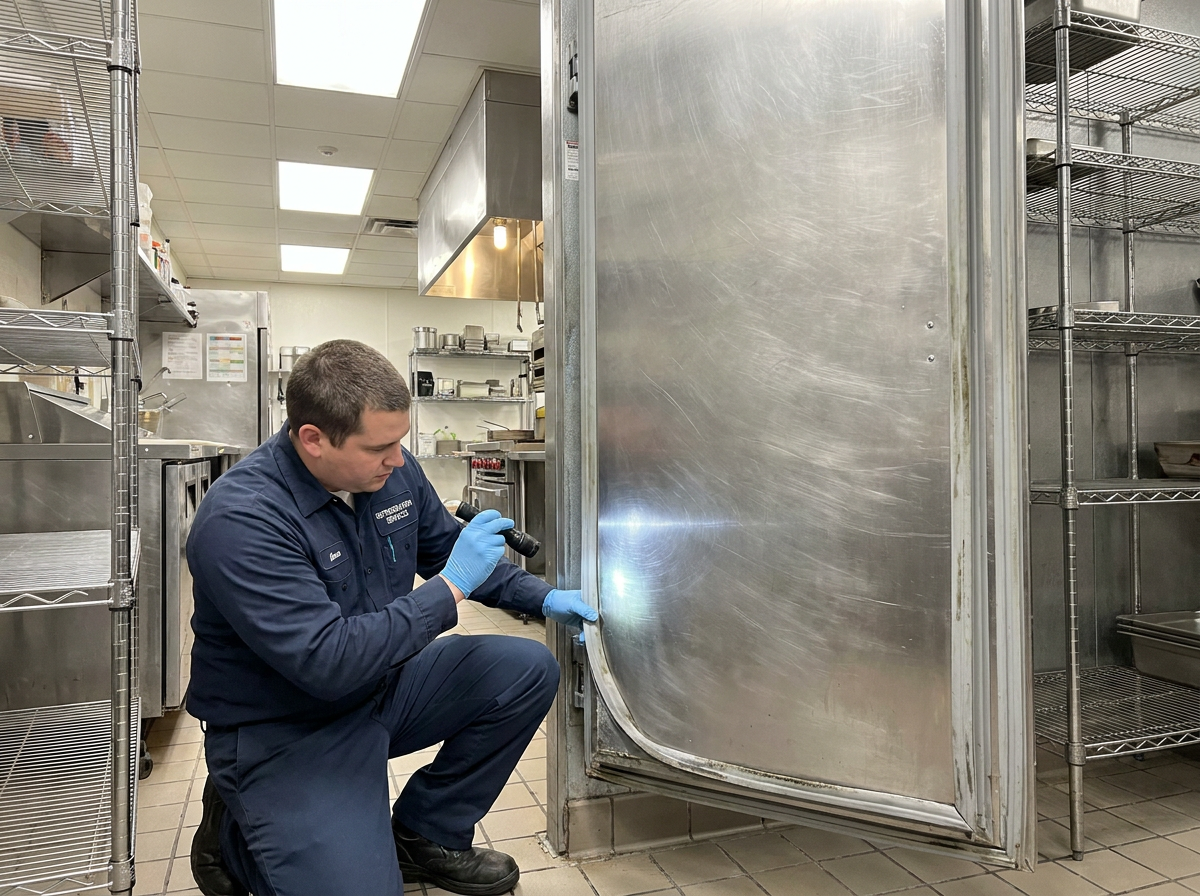
Your walk-in cooler is running warm. Or the energy bill spiked without explanation. Or there's frost building up around the door frame and the compressor sounds like it hasn't stopped in days. Before you call a refrigeration repair company — and before you budget for a compressor replacement — check the door seal. In our experience servicing commercial refrigeration throughout Northern California, the door gasket is behind the majority of walk-in cooler problems that operators mistake for mechanical failures.
This isn't a knock on repair companies. Compressors do fail. Refrigerant does leak. Defrost systems do malfunction. But far too often, those components are blamed for symptoms that a $200 gasket replacement would have solved — if anyone had checked the door seal first.
Why the Door Seal Is Almost Always the First Thing to Check
The walk-in cooler door gasket is the rubber seal that runs around the full perimeter of the door. Its job is simple: keep cold air in and warm air out. When it fails, warm, humid air infiltrates the cooler continuously — and that single failure cascades into a series of symptoms that look like much bigger problems:
- Temperature won't hold — the cooler can't maintain target temperature because it's fighting a constant stream of warm air through the door
- Compressor runs constantly — the compressor works overtime trying to compensate for heat gain it was never designed to handle indefinitely
- Frost and ice on evaporator coils — warm, humid infiltration air freezes on the coils, restricting airflow and reducing cooling efficiency further
- Energy bills spike — the unit is consuming far more power than it should, 24 hours a day
- Ice buildup around the door frame — condensation from infiltrating air freezes on the cold surface of the door frame
Every one of those symptoms can be caused entirely by a failing door seal — and every one of them will be attributed to something more expensive if the seal isn't checked first. A refrigeration technician who starts diagnosing from the compressor or refrigerant circuit, without first verifying the door seal is intact, may correctly identify a compressor that's struggling — without finding the root cause of why it's struggling.
The 2-Minute Door Seal Check You Can Do Right Now
You don't need a technician to check whether your walk-in cooler door seal is the problem. Here's the field test:
- Dollar-bill test — close the walk-in door on a dollar bill at 6–8 points around the full perimeter: top center, bottom center, both sides at mid-height, and all four corners. Pull the bill out at each point. A healthy gasket grips the bill firmly — you should feel real resistance. If the bill slides free easily at any point, the seal is compromised at that location.
- Visual inspection — look at the gasket up close. Healthy rubber is soft, smooth, and flexible. Signs of failure: cracks or splits in the rubber, sections that look flattened or crushed rather than rounded, any area where the gasket has pulled away from the door frame, and mold or mildew growing in the folds.
- Compression test — press the gasket at multiple points around the door. It should feel soft and spring back. Sections that feel hard, stiff, or don't rebound have lost their compression memory and are no longer sealing.
- Corner check — the corners of a walk-in cooler gasket take the most stress and fail first. Pull each corner section slightly away from the frame and look for separation, cracking at the joint, or visible gaps.
If this check reveals any failure points, you've likely found your problem — or at minimum a significant contributing factor to whatever is going wrong with your cooler.
Common Walk-In Cooler "Repair" Calls That Were Actually Gasket Problems
Here's what this looks like in practice — scenarios we see regularly when operators call us after spending money on repairs that didn't fix the underlying problem:
"We just had the refrigerant recharged but it's still running warm"
Refrigerant recharge addresses low refrigerant — but if warm air is constantly infiltrating through a failed door seal, the unit will struggle to hold temperature regardless of refrigerant level. The recharge was correct but incomplete; the seal was the root cause.
"They cleaned the coils but the compressor is still running all the time"
Dirty coils do cause the compressor to work harder. But coil cleaning alone won't fix a compressor that's overworked because of continuous heat gain through a compromised door seal. Both issues may be present — but the seal is often the bigger factor.
"We replaced the defrost timer but the ice keeps coming back"
Ice buildup on evaporator coils is often a defrost system issue — but it's also a classic symptom of humid air infiltration through a failing door seal. If the seal isn't replaced alongside the defrost repair, the ice will return regardless.
"Our energy bill went up 30% and we can't figure out why"
A failing walk-in door seal is one of the most common causes of unexplained energy cost increases in food service operations. Because the increase is gradual and the seal looks intact from a distance, it's easy to miss — and easy to attribute to utility rate increases or other equipment.
This Applies to Reach-In Coolers and Freezers Too
Walk-in coolers are the most common example because of the scale of the problem — a large door with a long gasket perimeter, often in a high-traffic area. But the same principle applies to every commercial refrigeration unit on your premises:
- Reach-in coolers and freezers — True, Hussmann, Beverage-Air, Traulsen, and other brand units all use retainer-style door gaskets that degrade over time. A True refrigerator gasket replacement, for example, is one of the most common preventative maintenance items on busy restaurant lines — and one of the most frequently skipped
- Undercounter units — lower height means the door takes more physical abuse from knees and feet; gaskets on undercounter units often fail faster than on upright coolers
- Display cases — grocery and convenience store display case gaskets are opened hundreds of times per day, accelerating wear dramatically
- Walk-in freezers — all the same issues as walk-in coolers, amplified by the extreme temperature differential and the additional strain on sub-zero rated gasket material
The dollar-bill test works on all of them. A 5-minute check across every unit on your premises gives you a clear picture of where door seal problems are contributing to the performance and energy issues you're experiencing.
When to Call for a Gasket Inspection vs. a General Repair
Here's a practical decision guide:
| Symptom | Start with |
|---|---|
| Temperature running 3–5°F above target | Gasket inspection |
| Frost or ice around door frame | Gasket inspection |
| Compressor running continuously | Gasket inspection first, then mechanical if gasket is good |
| Unexplained energy bill increase | Gasket inspection |
| Heavy ice on evaporator coils | Gasket inspection + defrost system check |
| Unit completely not cooling | General refrigeration repair (likely mechanical) |
| Loud unusual noises from compressor | General refrigeration repair |
| Refrigerant leak indicators | General refrigeration repair |
The rule of thumb: if the unit is still cooling — just not cooling well, or working too hard to do it — start with the door seal. If the unit has stopped cooling entirely or has obvious mechanical failure, that's a general repair call. But even then, get the gaskets inspected at the same time so you're not fixing the compressor only to have it fail again because of a seal problem.
What a Professional Gasket Inspection Covers
When Cal Gaskets does a walk-in cooler inspection, we go further than the dollar-bill test:
- Full perimeter compression check on every door
- Visual inspection of gasket material condition — including internal foam core, corner joints, and adhesion to the retainer channel
- Door alignment check — a door that's out of square creates uneven gasket compression and chronic leak points that a new gasket alone won't fix
- Hinge and closer condition — worn hinges let the door sag over time, pulling the gasket out of contact on one side
- Anti-sweat heater wire check on freezer doors — a failed heater wire causes condensation and accelerated gasket wear at the frame
- Photo documentation of all findings — so you have a clear record of what was found and what was done
The inspection is free. If we find gaskets that need replacement, we custom-fabricate them on-site and install in the same visit. If everything looks good, we tell you that — and you have a documented baseline for future inspections.
Walk-In Cooler Problem? Get the Door Seal Checked First — Free.
Cal Gaskets provides free on-site door seal inspections for walk-in coolers, walk-in freezers, and all reach-in commercial refrigeration throughout the Bay Area, Sacramento, and the North Bay. We'll tell you honestly whether the gasket is your problem — and if it is, we can fix it the same visit.